Caulk vs silicone, and the two questions that settle it
Will it be painted, and will it get wet? What five manufacturer data sheets say about paint, movement, shrinkage and where each one must not go.
By The Damp GuyLast updated
The short version
Decorators caulk is an acrylic that takes paint. Silicone keeps water out and won't take paint at all. So two questions settle it: will you paint over it, and will water sit on it? Skirting, coving, architraves and the crack where the wall meets the ceiling get caulk. Baths, showers, basins and worktops get sanitary silicone. And the line everyone repeats, that silicone is the flexible one, is shakier than it sounds. One maker's sanitary silicone carries the same 12.5% movement figure as its own decorating caulk.
Five data sheets, side by side
Movement, paint and shrinkage, as each maker publishes them. These are the manufacturers' laboratory figures, not mine, and the products are named because the numbers belong to them.
| Sealant | Movement it is rated for | Can you paint it? | Shrinkage |
|---|---|---|---|
| Decorators caulk (acrylic)Everbuild Caulk Once, Sika data sheet, October 2020, version 01.02 | 12.5%, plastic (ISO 11600 F12.5P) | Yes, after 1 hour | Under 25% |
| Decorators caulk (acrylic)UniBond Trade 121 Decorating Caulk, Henkel data sheet, version 27.10.2017 | 12.5% (ISO 11600) | Yes, after 1 hour, if the paint can follow the joint (in general under 5% movement) | About 30% |
| Frame sealant (acrylic)Everbuild External Frame Sealant, Sika data sheet, March 2018, version 01.01 | 12.5%, low to medium (EN 15651-1) | Yes, once skinned (at least 1 hour) | Not stated |
| Sanitary siliconeSikaSeal Sanitary Silicone +, Sika data sheet, April 2026, version 01.01 | 20%, low modulus (ISO 11600 F and G 20LM) | No | 10% or less |
| Sanitary siliconeUniBond Sanitary Sealant, Henkel data sheet, issued 21 March 2023 | 12.5%, elastic (F-12.5E) | No | 20% |
Source: each manufacturer's own data sheet, read 6 October 2026 and linked at the foot of this page. Shrinkage is the change of volume measured to ISO 10563.
Read the paint column first, because it's the one with no exceptions. Every acrylic on the list takes paint. Neither silicone does. Then look at the movement column and notice it doesn't split the way you'd expect.
Silicone isn't the flexible one by default
The number on a sealant data sheet is its movement capability, a percentage that the ISO 11600 scheme runs from 7.5% to 25%. UniBond's decorating caulk is rated 12.5%. So is UniBond's sanitary silicone. On that number alone, the caulk and the silicone are level.
The difference is the letter after it. Under the ISO 11600 scheme a sealant's class marks it as elastic (E) or plastic (P). The UniBond silicone is classed F-12.5E. Caulk Once, a decorators caulk from Everbuild, is classed F12.5P. The silicone sheet backs its letter with an elastic recovery of 95%. None of the caulk sheets I read gives a recovery figure at all.
A bigger number does exist. Sika's sanitary silicone is rated 20%, low modulus. But that's a property of one product, not of the word silicone, so read the sheet rather than the label.
Shrinkage is the other gap, and it's bigger. UniBond's caulk is water based, and its sheet gives a change of volume of about 30%. Caulk Once is under 25%. The two silicones are 10% or less and 20%. A caulk bead in a wide gap loses a lot of itself as it dries, and it's slow about it too: UniBond gives about 10 days per 5 mm to cure, where its silicone does 2 mm a day.
Paint decides most of it
If the joint is going to be painted, the choice is already made.
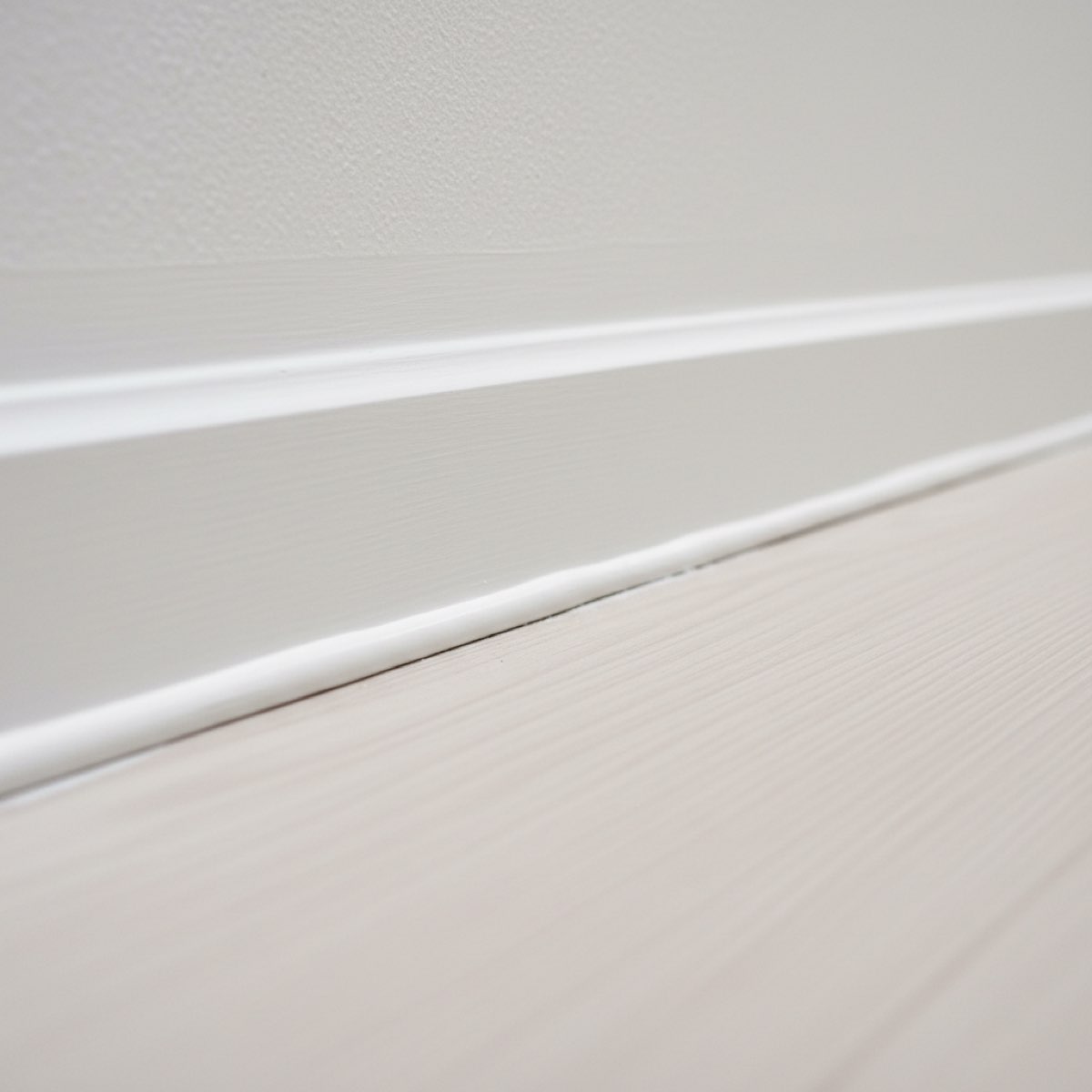
Both caulks can be painted an hour after they go on. The acrylic frame sealant can be painted once it has skinned, which its sheet puts at a minimum of an hour. Both silicone sheets say flatly that theirs can't be painted. Sika's goes further and points you to a different, overpaintable sealant from its own range when paint is needed, and that one is for outside use only.
Paint over caulk has its own catch, and the caulk sheets print it. UniBond's says its caulk may only be painted if the paint can follow the joint's movement, which it puts in general at under 5%, or the paint can crack. Everbuild's says some poor quality paints, especially certain vinyl matts, have very little movement once dry and can crack if the joint moves too much. So a hairline crack along the top of freshly painted skirting can be the paint giving up, with the caulk underneath still intact.
And caulk doesn't go over silicone. Every caulk and acrylic sheet I read asks for old sealant to be removed before you apply, so the silicone comes out first. Getting old silicone off cleanly is a job of its own, and it's the step that decides whether anything new will stick.
Water decides the rest
Round a bath or a shower, this stops being about looks.
Neither caulk sheet lists a bath, a shower or a sink among its uses. They list skirting, coving, stairs, frames and gaps before decorating. Caulk Once's sheet says it should not be used in conditions of continuous immersion. Both silicone sheets list baths, showers and basins, and both contain a fungicide. UniBond's is rated level 0 for microbiological growth under ISO 846.
That matters more on this site than the finish does. The seal round a bath is the only thing between the water on the tiles and whatever sits under the bath, so a bath seal that has let go is a damp problem as much as a tidy one. Which silicone suits which wet area, and what "waterproof" on the tube does and doesn't promise, is the bathroom sealant page's whole job.
The fungicide is there to stop mould growing on the sealant. It does nothing about the air in the room. Sika's sheet pitches its silicone at areas subject to condensation, and if your bathroom streams every morning, the seal is the smaller problem: condensation is a moisture problem in the room, and it is fixed by getting the wet air out. If the bead has already gone black, if it cleans up or has to come out depends on how far in the mould has grown.
Where silicone shouldn't go
Straight from a sanitary silicone's own data sheet, plus what a second one adds.
- Anything you want to paint. Both sheets say it can't be painted.
- The outside of a uPVC window frame. The sheet says not to use it for perimeter pointing of uPVC, and names a frame silicone instead.
- Near the edge seal of a double glazed unit. Not in the vicinity of it, and not in conjunction with it.
- Lead, brass, bitumen and asphalt. Soft metals and bitumen are both ruled out.
- New concrete or stonework, unprimed. Highly porous surfaces need priming first. The second sheet rules out natural stone altogether.
- Anything that bleeds oil or plasticiser. The second sheet names butyl, EPDM and polychloroprene rubbers, and adds PTFE, polypropylene and polyethylene as surfaces it isn't recommended on.
- Under water. The second sheet rules out swimming pools, aquariums and applications under water.
Windows are where both get misused
Inside the frame and outside it are two different jobs, and the sheets treat them that way.
Inside, caulk is the normal answer. UniBond's decorating caulk lists interior window and door frames in wood, uPVC and aluminium, and you can paint it to match the sill.
Outside is where people reach for whatever is in the bathroom cupboard, and on uPVC that is wrong twice over. The sanitary silicone sheet says not to use it round the perimeter of uPVC frames. The acrylic frame sealant sheet says not to use that one externally round PVCu either. Outside on timber or metal frames, the acrylic frame sealant is listed, and its sheet recommends painting it outside to make it last longer. Gap sizes and which sealant goes outside on which frame are on the sealing around windows page.
One thing a new bead won't settle. If the wall inside the window is wet after rain, you might be looking at water getting in from outside, and that has to be traced to where it gets in before a fresh bead is worth anything.
About this resource
Every figure here comes from a manufacturer's own data sheet: two decorators caulks, an acrylic frame sealant and two sanitary silicones from Sika and Henkel, plus Sika's exterior overpaintable sealant. Each was read on 6 October 2026, and each says its figures come from laboratory tests. What the class letters mean comes from Soudal's guide to ISO 11600 classification. Brands are named because the numbers are theirs, not as recommendations.
I haven't tested any sealant on this page. This site doesn't survey, treat or quote for work.
Common questions
Should I use decorators caulk or silicone?
Ask two things about the joint: will it be painted, and will water sit on it? Painted and dry, like skirting, coving, architraves and the line where a wall meets the ceiling, wants decorators caulk, which is an acrylic you can paint after about an hour. Wet, like a bath, shower, basin or worktop, wants a sanitary silicone, which carries a fungicide and cannot be painted. If a joint is both wet and meant to be painted, the silicone wins and the paint stops short of it.
Can I use decorators caulk instead of silicone round a bath?
I wouldn't. Neither decorators caulk data sheet I read lists baths, showers or sinks among its uses. They list skirting, coving, frames and gaps before decorating. One says outright that it should not be used in conditions of continuous immersion. Both sanitary silicone sheets list baths, showers and basins first, and both contain a fungicide. Round a bath, use the product written for a bath.
Can I paint caulk over silicone?
No. Both silicone data sheets say the silicone cannot be painted, and every caulk and acrylic sealant sheet I read asks for old sealant to be removed before you apply. Caulk laid over a silicone bead is sitting on the one surface its maker tells you to clear first. Cut the silicone out, clean off what is left, then caulk and paint.
Where should you not use silicone?
Anywhere you want to paint, first. A sanitary silicone's own data sheet then rules out bitumen and asphalt, soft metals such as lead and brass, surfaces that bleed oils, solvents or plasticisers, the edge seal of a double glazed unit, the perimeter of a uPVC window frame, and highly porous new concrete or stonework unless it is primed. A second sanitary silicone sheet adds natural stone, swimming pools, aquariums and anything under water.
What will silicone not stick to?
One sanitary silicone sheet says it is not recommended on PTFE, polypropylene or polyethylene, and that on butyl, EPDM or polychloroprene rubbers it may discolour or lose adhesion. Another says highly porous surfaces such as new concrete or stonework need priming first. Both want the surface clean and dry, with all old sealant and any mould taken off before the new bead goes on.
Is caulk or silicone better for windows?
Inside, caulk. A decorating caulk sheet lists interior window and door frames in wood, uPVC and aluminium, and it takes paint. Outside, it depends on the frame. Round the outside of a uPVC frame, the bathroom silicone sheet and the acrylic frame sealant sheet both say not to use them there, and the silicone one names a frame silicone instead. Round outside timber or metal frames, an acrylic frame sealant is listed, and its sheet recommends painting it outside to make it last longer.
Sources (7)
- Sika, Everbuild Caulk Once product data sheet (October 2020, v01.02), read 6 October 2026
- Henkel, UniBond Trade 121 Decorating Caulk technical datasheet (version 27.10.2017), read 6 October 2026
- Sika, Everbuild External Frame Sealant product data sheet (March 2018, v01.01), read 6 October 2026
- Sika, SikaSeal Sanitary Silicone + product data sheet (April 2026, v01.01), read 6 October 2026
- Henkel, UniBond Sanitary Sealant technical data sheet (issued 21/03/2023), read 6 October 2026
- Sika, Everbuild Weather Mate product data sheet (July 2018, v02.01), read 6 October 2026
- Soudal UK, Silirub range leaflet, "A Guide to ISO 11600 Classification", read 6 October 2026