How to remove silicone sealant, and why nothing in the cupboard dissolves it
Cut the bead out, then soften the film that is left. What white spirit, WD-40, meths and vinegar actually do to cured silicone, how long the remover makers say to wait, and which bath rules out which product.
By The Damp GuyLast updated
The short version
Cut the old silicone out with a blade, pull out as much as you can, and only then put a remover on the thin film that is left. Cured silicone does not dissolve in anything you keep at home. The best a household solvent does is swell it, and the strongest of them, the hydrocarbons in white spirit and WD-40, swelled it by about a third in published lab tests. Meths, acetone and vinegar barely touch it. That is why remover spread on a full bead seems to do nothing. Finish with a methylated spirit wipe and a dry surface, because new sealant will not stick to old residue, soap or an oily film.
Cut it out first, then deal with the film
The order matters more than the product. Every remover maker writes its instructions for a joint that has already been scraped.
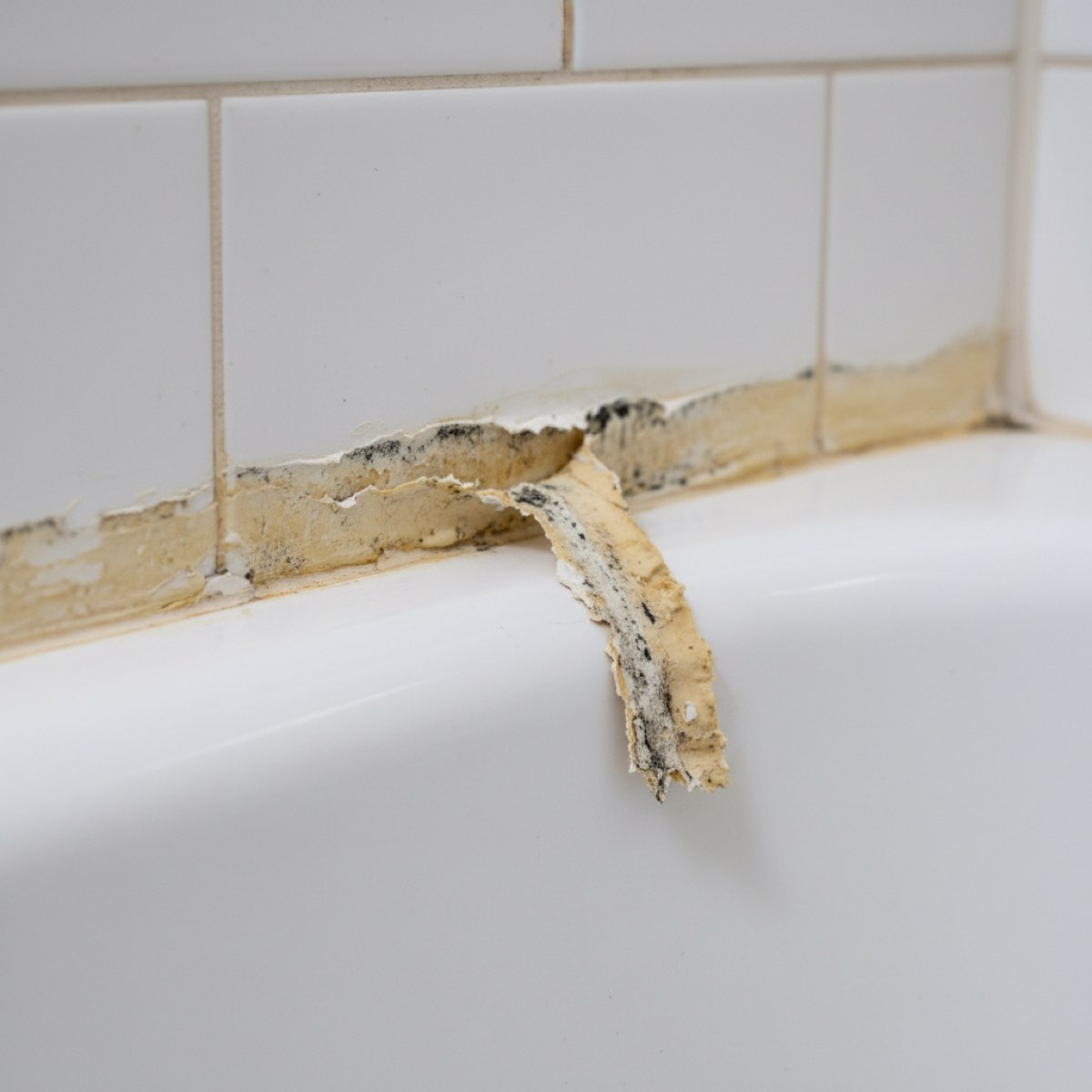
Start with the blade. Run it along the edge where the silicone meets the tiles, then along the edge where it meets the bath or tray, keeping it flat to each surface. Pull the strip out, then go back over the joint with a removal tool. Soudal's remover sheet opens with the same step: remove the cured sealant as much as possible using a sharp knife. UniBond's says the same about its gel.
What is left after that is a film. It is thin, it is stuck in the texture of the tile, and it is the part people give up on. This is where a solvent or a remover earns its keep, because a thin film swells through and lets go. A full bead only swells on the outside.
Owners who have tried both say the same thing. One put remover on whole beads and found it did nothing at all, not even softening them. Another explained why: people put it on full beads and expect them to come off, when the job is to cut away as much as you can and use the remover on the thin layer left.
If the bead was black with mould, the sealant makers want the mould gone as well before the new bead goes in, and why mould grows into silicone and keeps coming back is a page of its own. And if the seal had failed long enough for water to get behind it, the full reseal job, and what a failed bath seal does to the ceiling below, is worth reading before you buy anything.
What each household solvent actually does to cured silicone
Measured, not guessed. Cured silicone was soaked in each solvent for 24 hours and its length measured before and after.
Ask three people about white spirit and WD-40 and you will get three answers, and none of them will tell you why. The why is in a 2003 paper in Analytical Chemistry by Lee, Park and Whitesides, which measured how much cured silicone swells in dozens of solvents. Match what is in your cupboard to what they tested and the argument settles itself.
| In your cupboard | What's in it | Closest solvent tested | How much it swelled |
|---|---|---|---|
| White spirit | C9 to C12 hydrocarbons (Barrettine safety data sheet) | hexanes, n-heptane | 35% longer (S 1.35); 34% longer (S 1.34) |
| WD-40 Multi-Use | 60 to 80% C9 to C11 hydrocarbons (WD-40 safety data sheet) | hexanes, n-heptane | 35% longer (S 1.35); 34% longer (S 1.34) |
| Nail varnish remover (acetone type) | Acetone, 90% or more (The Gel Bottle safety data sheet) | acetone | 6% longer (S 1.06) |
| Methylated spirits | Ethanol, over 90% (Barrettine safety data sheet) | ethyl alcohol | 4% longer (S 1.04) |
| Vinegar | Acetic acid (as reported by the Express) | acetic acid, undiluted, water | none (S 1.00); none (S 1.00) |
Source: Lee, Park and Whitesides, Analytical Chemistry, 2003, Table 1, with undiluted acetic acid from Table 4. S is the swollen length over the dry length, so S 1.34 is a piece 34% longer. What is in each product comes from its own safety data sheet; vinegar's acetic acid is as reported by the Express.
Two honest limits. The paper tested a lab silicone with no filler, not the sealant round your bath, so read the table as which kind of solvent works, not as an exact figure for your joint. And the paper did not test isopropyl alcohol, so there is no row for it.
The pattern is plain enough to act on. The hydrocarbons, which is what white spirit and WD-40 are mostly made of, swell cured silicone by about a third. That is enough to loosen a film. Alcohol, acetone and acetic acid hardly move it, and water does nothing at all. The paper does list a few chemicals that dissolve this silicone outright. They are laboratory reagents, strong acids among them, and none of them belongs anywhere near a bathroom.
So vinegar is the wrong tool for this job. It gets recommended for cleaning mould off a bead, which is a different job again.
Silicone sealant remover: how long the makers say to wait
Their own data sheets, side by side. The waits run from ten minutes to twelve hours, which is why a remover given ten minutes on a thick bead looks like it failed.
| Product | What the maker says it does | Wait the maker states | What it rules out |
|---|---|---|---|
| Soudal Silicone Remover | Based on hydrocarbons; you scrape off the softened remnants | At least 10 minutes, repeat if needed | Nylon and PMMA (acrylic); can stain porous surfaces |
| Everbuild Silicone Eater | Denatures silicone so it rinses off; coat at twice the bead thickness | 2 to 4 hours, washed off by 4 hours; water kills it | May attack PU-coated (re-enamelled) baths, nylon, coloured anodised shower trim |
| UniBond Silicone Sealant Remover | A gel that breaks down residue; scrape once it has swollen | At least 3 hours; 6 to 12 hours over 2 mm thick | Natural stone, brass, copper, nylon |
| WD-40 Multi-Use | Sprayed on to ease scraping; the company says the use is untested by it | A few minutes | Remove it completely before resealing, as the two can react |
Source: each maker's own technical data sheet or guidance, read October 2026. It is not a ranking, and none of them was tested. It is here so that whichever you buy gets the wait its own label asks for.
Read the thickness rule before anything else. UniBond asks for the sealant to be covered with at least 5 mm of gel, then gives a wait of at most 4 hours under 2 mm thick and 6 to 12 hours over it. Everbuild asks for a coat twice as thick as the silicone underneath. Both are telling you the same thing as the owners above: the less silicone you leave, the less time and product it takes.
Two warnings from the sheets are easy to miss. Everbuild's product is irreversibly nullified by contact with water, so a damp joint wastes it. And WD-40 is the one item in the table whose maker says it has not tested the use, and that the residue has to come off before new silicone goes on.
Every sheet that mentions it says to try the product on a hidden patch first. Everbuild asks for a 2 hour test patch before you do the whole job. That costs you an afternoon, and it is cheaper than a marked bath.
Acrylic or enamel: check the bath before the blade or the solvent
The product and the tool both depend on what the bath is made of, so find that out first.
If your bath is acrylic, sealant makers list that plastic as PMMA. Soudal's remover sheet rules out PMMA by name. An acrylic bath maker tells owners to avoid abrasive cleaners, scourers and organic solvents such as acetone, because they scratch the acrylic and dull the finish. So on an acrylic bath, nail varnish remover is out, a scouring pad is out, and any remover has to be one whose sheet does not exclude acrylic, tried on a hidden patch.
Blades follow the same split. Owners who have done this say a metal razor scraper works on tiles, and on the bath you need a plastic blade unless it is enamel. Everbuild adds one more case: its remover may attack a PU-coated bath, which is a bath that has been re-enamelled. If yours has been resurfaced, treat it like the delicate one.
Porous surfaces are their own trouble. Soudal warns that its remover can stain them, and UniBond's gel is not for natural stone. On a stone worktop or sill, the blade does as much as it can and the chemical stays in the tin unless the label says otherwise.
Why the new bead needs bare, clean surface under it
Laying fresh silicone over the old is the shortcut everyone is tempted by, and it wastes the cartridge.
The sealant makers do not leave room for argument here. UniBond's bathroom sealant sheet says residues of old sealant, and mould, must be removed completely, and that surfaces must be clean and dry, free from dust and grease. Its how-to says the new sealant won't adhere unless the surface is clean and dry.
There is one product sold to go over old sealant, a coating called Re-New. Its own data sheet says a working, waterproof seal must already be in place before you use it, and that it will not provide a seal on its own. So it can freshen a seal that still works. It cannot fix one that leaks.
Three things sabotage a clean joint after all that scraping. Remover left on the surface, which is why UniBond says to wipe the area clean and then go over it with methylated spirit before resealing. The oily film from WD-40, which its maker says must be completely removed. And soap: Soudal's sanitary silicone sheet says that if a soapy finishing solution touches the surface, the sealant will not stick to it. Don't wash the joint down with washing-up liquid as the last step.
Then check it with your fingers. It should feel smooth, with no remnants of the old sealant. Give it time to dry properly too, because a wet joint is no better than a dirty one, and how long the new silicone needs before the shower goes back on is the next question you will have. The bead itself, the tape and the smoothing are all on how to apply silicone sealant neatly.
One last reason to do it properly. A seal that lets water past at the back of a bath or shower tray sends it somewhere you can't see, and a mark on the ceiling under a bathroom is one place it can show. It is the same rule as anywhere else on this site: water getting in has a location, and a gap in a bead of silicone is a location. If you would rather not do the job yourself, what it costs to have a bath resealed is on its own page.
About this resource
The swelling figures come from Lee, Park and Whitesides, "Solvent Compatibility of Poly(dimethylsiloxane)-Based Microfluidic Devices", Analytical Chemistry, 2003, which tested a lab silicone rather than a bathroom sealant. The remover waits, exclusions and resealing rules come from the makers' own data sheets for Soudal, Everbuild and UniBond products and from WD-40's own guidance, and the acrylic advice from an acrylic bath maker. All were read in October 2026, and the full list is under Sources below.
Nothing on this site earns a commission. No remover was tested for this page. This site does not survey, treat or quote for work.
Common questions
Does WD-40 remove silicone sealant?
It helps, and it does not dissolve it. WD-40 Multi-Use is 60 to 80% hydrocarbons by its own safety data sheet, and hydrocarbons swelled cured silicone more than anything else you are likely to have at home. That softens a thin film so it scrapes off easier. WD-40's own page says to let it sit for a few minutes, and to remove it completely before you put new silicone on, as the two can react. So it adds a cleaning step of its own.
Can white spirit remove silicone?
It can soften the last thin film, and it will not shift a bead. White spirit is the same hydrocarbon class as WD-40, and in the published lab data that class made cured silicone swell by about a third. Swelling is not dissolving. Cut the bead out first, then use white spirit or a remover on what is left, and finish with a methylated spirit wipe before you reseal.
Will methylated spirits remove silicone?
Not as a remover. Meths is over 90% ethanol, and ethanol swelled cured silicone by 4% in the lab data, which is next to nothing. Where meths earns its place is at the end: the UniBond remover sheet says surfaces to be resealed should be cleaned with methylated spirit before fresh sealant goes on.
Does nail polish remover dissolve silicone?
No. The acetone type swelled cured silicone by 6% in the lab data, and non-acetone removers use other solvents again. Keep it well away from an acrylic bath in any case: an acrylic bath maker tells owners to avoid organic solvents such as acetone because they dull the finish.
What is the fastest way to remove silicone sealant?
A sharp blade and a removal tool, used before any chemical. Cut along both edges, pull the bulk out, and the remover only has a thin film left to work on. Remover on a full bead is the slow way. The remover sheets tell you to scrape off as much as you can first, and UniBond's stated wait grows with the thickness left.
What if I can't get all the old silicone off?
Then the new bead is sitting partly on old sealant, and the sealant makers do not allow for that. UniBond says residues of old sealant must be removed completely. Put remover on what is left at the thickness its sheet asks for, give it the full stated wait, and repeat, which UniBond and Soudal both allow. Then check by touch: it should feel smooth with no remnants.
Sources (20)
- Lee, Park and Whitesides, "Solvent Compatibility of Poly(dimethylsiloxane)-Based Microfluidic Devices", Analytical Chemistry 2003 (Whitesides group PDF, archived), read 6 October 2026
- Henkel, UniBond Silicone Sealant Remover technical data sheet (US11000, issued 21/03/2023), read 6 October 2026
- UniBond, How to remove silicone sealant easily, read 6 October 2026
- Soudal, Silicone Remover technical data sheet (revision 19/12/2023), read 6 October 2026
- Sika Everbuild, Silicone Eater product data sheet (August 2022), read 6 October 2026
- WD-40 UK, How to remove silicone sealant, read 6 October 2026
- WD-40 Multi-Use Product safety data sheet (revision 01.11.2021), read 6 October 2026
- Barrettine White Spirit safety data sheet, read 6 October 2026
- Barrettine Mineralised Methylated Spirits safety data sheet, read 6 October 2026
- The Gel Bottle, Acetone safety data sheet, read 6 October 2026
- Henkel, UniBond Kitchen and Bathroom Anti-Mould technical data sheet (US1000), read 6 October 2026
- Henkel, UniBond Kitchen and Bathroom Triple Protection technical data sheet (US5000), read 6 October 2026
- Henkel, UniBond Re-New technical data sheet (US3500), read 6 October 2026
- Soudal, Trade Sanitary Silicone technical data sheet, read 6 October 2026
- Trojan Baths, Acrylic bath aftercare, read 6 October 2026
- Express, Remove silicone sealant mould in 15 minutes, read 6 October 2026
- r/DIYUK, how to quickly and cleanly remove silicone sealant, read 6 October 2026
- r/DIYUK, Is sealant remover actually worth using?, read 6 October 2026
- Toolstation, How to remove silicone sealant, read 6 October 2026
- Screwfix, How to remove silicone sealant, read 6 October 2026