The damp proof course, and the two minutes that could save you thousands
Your damp proof course has a height above the ground you can check yourself with a tape measure. What a DPC is, how the system is meant to work, and the everyday things that defeat it.
By The Damp GuyLast updated
The short version
A damp proof course is a continuous impermeable layer near the base of a wall. It stops ground moisture travelling up into the building. Approved Document C says that on an external wall it should be at least 150mm above the level of the adjoining ground. Go and measure it. If a path, a patio, a raised border or a coat of render has taken the outside ground level up to or above that line, your DPC is bridged, and moisture has a route around it. A bridged DPC makes damp at low level that looks exactly like the thing people pay thousands to have injected. The check costs you nothing and takes two minutes.
Go and measure it
Skip the rest of this if you like. Do this bit today.
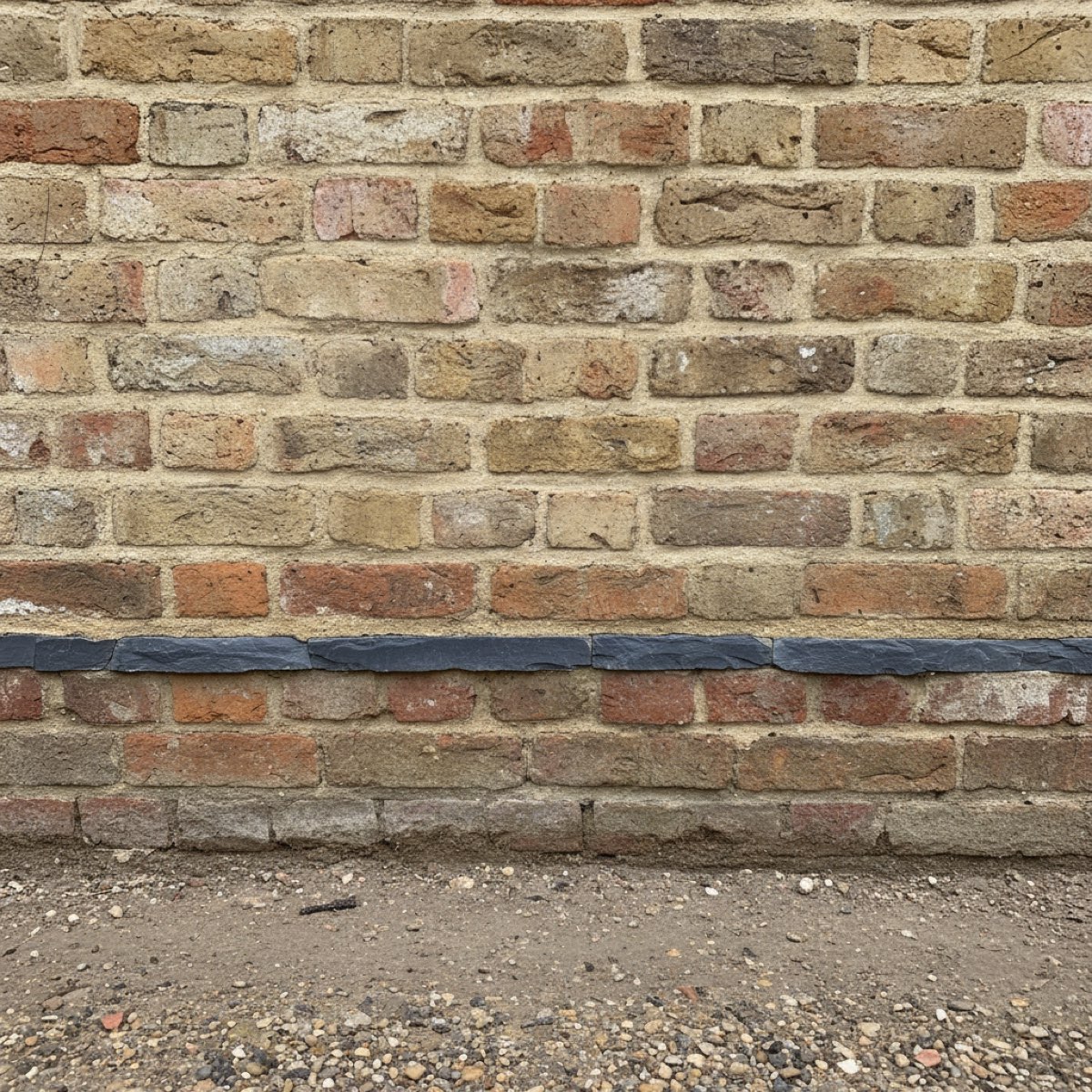
Walk round the outside of the house and look at the brickwork near the ground. On most houses you can see the damp proof course as a thin line in a mortar joint, two courses or so up: a slate, a dark bituminous strip, or a plastic edge. On some it is a course of engineering brick, denser and darker than the rest.
Then measure from the ground up to it. Approved Document C asks for at least 150mm above the level of the adjoining ground, unless the design is such that part of the building protects the wall. The purpose it states: keep rain splashback and standing water in heavy rainfall away from the wall above that line.
Come up short of 150mm and you have learned something worth knowing before anyone diagnoses anything. Same if you cannot find the line at all, because render or paving covers it. In the words of one long-standing paving reference, it is also the sort of thing surveyors notice when valuing a property.
Ordinary domestic life is what defeats that height. Paving levels creeping up over the years. A raised bed or border banked against the wall. Decorative render carried down across the DPC line. Steps or access ramps built flush with the internal floor.
It is a system, not a strip
The damp proof course is one part. A cavity wall has three more, and those three are where it quietly goes wrong.
| Part | What Approved Document C says | How it fails |
|---|---|---|
| The DPC itself | At least 150mm above adjoining ground, and continuous with any damp-proof membrane in the floors | Bridged by ground level, paving or render; or not continuous with the floor membrane |
| The cavity below it | Taken down at least 225mm below the level of the lowest DPC | Filled with mortar droppings and debris, which carry moisture across |
| The cavity tray | An alternative to taking the cavity down, provided so precipitation cannot pass to the inner leaf | Missing, or lacking stop ends where it does not run the full length |
| Weep holes | Every 900mm, and at least two above an opening where the tray is short | Never installed, painted over, rendered across or blocked |
Weep holes are the ones people fill in. They look like missing mortar, so at some point somebody points them up. Now the water the tray was collecting has nowhere to go but inward.
A fifth place needs damp proofing, and it has nothing to do with the ground. Approved Document C says damp proof courses should be provided to direct moisture towards the outside where the downward flow would be interrupted at an obstruction such as a lintel. Also where sills or reveals, including their joints, do not form a complete barrier at openings, windows and doors. That is why damp turns up at the head of a window, or under a sill, on a wall that is perfectly sound at the bottom.
What a DPC is made of, and whether yours has one
Approved Document C accepts a damp proof course of bituminous material, polyethylene, engineering bricks or slates in cement mortar, or any other material that will prevent the passage of moisture. Historically that meant slate or dense engineering brick. Modern work is usually a polyethylene or bitumen-polymer membrane. The design and installation standard it names is BS 8215:1991, "Code of practice for design and installation of damp-proof courses in masonry construction".
"Do all houses have one?" gets asked a lot, and the answer disappoints. Modern construction has to. Older houses vary, and the sources disagree about the history. One widely used reference states DPCs have been mandatory in British buildings since the Public Health Act 1875. Others state plainly that the 1875 Act never mentions damp proof courses at all, that this is a repeated misconception, and that the Act instead empowered local authorities to make byelaws, with those byelaws increasingly requiring DPCs from the late 1870s. I have not read the Act itself, so I will not settle it for you.
Either way, the practical version holds. A build date does not tell you whether your house has an intact damp proof course. Looking at the wall does.
How long does one last, and what is a guarantee worth?
You will find confident lifespans quoted for damp proof courses. I could not trace one to a published source worth standing behind, so you get no number here. Two things can be said. Slate and engineering brick are still doing their job in houses well over a century old. And a DPC usually stops working because something bridged it, not because the material expired.
The guarantee question is two questions wearing one coat. First, are the product and the workmanship sound? Second, will the company that issued the paper still exist in fifteen years? A guarantee from a dissolved company is a document, not a remedy. That is why an insurance-backed guarantee is a different product from a contractor's own, and it has a price you can see on the quote.
"Can damp come back after damp proofing?" answers itself once you have read the rest of this page. Say the wall was damp because the ground level sat above the DPC. Injecting a new chemical course into the brickwork has not moved the ground. Whether the original diagnosis was sound is a question about the test that was run, and it is the one worth going back to.
What to check, and what to ask
The first three you can do yourself, in daylight, before anybody comes round. The last two are for whoever turns up to quote.
- Measure the height, all the way round. Under 150mm to the adjoining ground on any elevation, and you want to know that before anyone quotes.
- Look for render crossing the line. Render carried down past the DPC hands moisture a continuous path over the top of it.
- Look for weep holes above openings, and check they are open. Every 900mm is the figure, and at least two above an opening where the tray is short.
- Ask what the ground level is doing before you accept an injection quote. If nobody has mentioned it, ask why not.
- Ask whether the quote includes putting the outside right. A new chemical course inside a wall whose ground level still bridges it is money spent on the wrong side of the wall.
About this resource
The requirements quoted here are Approved Document C, "Site preparation and resistance to contaminants and moisture", 2013 edition, paragraphs 5.4, 5.5 and 5.30, which is published free. BS 8215:1991 and BS 8102:1990 are named by title only. The everyday breach list and the surveyor observation come from the paving reference Pavingexpert.
No lifespan figure, because none could be sourced. No verdict on the 1875 legislation, because the sources contradict each other and I have not read the Act. Ground levels and drainage can involve structure and drainage law, so this page tells you what to measure and what it means, not how to do the work. This site does not survey, treat or quote for work.
Common questions
How many years does a damp proof course last?
No lifespan is given here, because no published figure could be traced to a source worth standing behind. What can be said is that slate and engineering brick courses are still working in houses well over a century old, and that a damp proof course usually stops working because something bridged it rather than because the material wore out. A quoted lifespan is doing a job for whoever is quoting it.
How do I know if my house needs a damp proof course?
Start with the tape measure, not the quote. Find the line in the brickwork near the ground and check it sits at least 150mm above the adjoining ground on every elevation. If it does not, or you cannot find it because paving or render has covered it, you have a bridge, and a new course injected inside the wall does not move the ground outside it. Only after that is settled does the question of what the wall needs make any sense.
Can you install a damp proof course without removing the plaster?
The drilling and injection can be done without touching much of it. Whether that leaves you with a dry-looking wall is another matter, because plaster on a wall that has been damp usually carries salts, and salted plaster keeps pulling moisture out of the room air afterwards. That is why hacking off and re-plastering appears on nearly every quote, and why it is often the larger half of the bill.
What can I put on the walls to stop damp coming through?
Nothing you apply to the inside face changes where the water is coming from, and a coating over a bridged damp proof course simply moves where the damp shows up. The regulations treat this as a system rather than a surface. The damp proof course should be continuous with any damp proof membrane in the floors, and separate courses are required at lintels, sills and reveals to direct moisture back outside. A break anywhere in that chain is a route in, and paint is not a repair for it.
Can damp come back after damp proofing?
Yes, and the two reasons are worth separating. Either the original diagnosis was wrong, in which case the treatment was never going to work, or it was right and something is still bridging the course. Check the ground levels, the render line and the weep holes before anyone comes back to re-treat. A guarantee covers the work that was done. It does not cover the wall being damp for a reason nobody looked at.