Damp meter readings, and why there is no acceptable number
The reading almost every damp quote in the country rests on is a wood measurement. What the meter is really telling you about a wall, and what it would take to settle the question properly.
By The Damp GuyLast updated
The short version
There is no acceptable damp meter reading for a wall. Hunting for one is the wrong question. On wood, the meter measures actual moisture content. On anything else it reports wood moisture equivalent, which the manufacturer defines as the moisture a piece of wood would theoretically reach sitting against that material. A wood scale, calibrated from oven-dried wood samples, held against your plaster. On top of that, saturation moisture content varies between 4% and 25% depending on the brick, so one number cannot mean the same thing in two different walls. A high reading gives you a reason to investigate. It does not measure how wet your wall is, and it is not a diagnosis.
The number on the screen is a wood measurement
That is not a dig at the instrument. It is what the people who make it say it does.
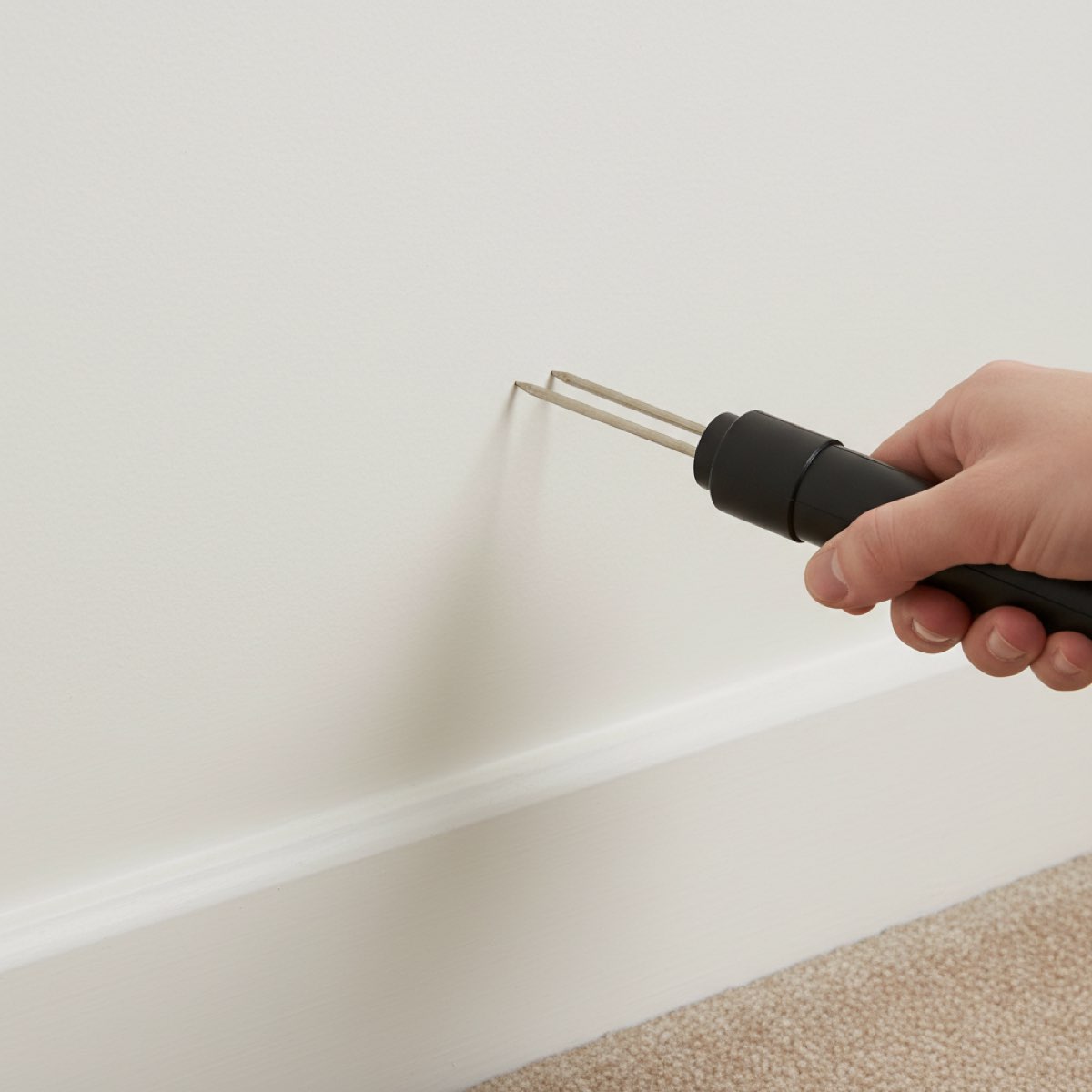
A pin-type meter pushes current between two probes and measures electrical resistance. Water conducts, so more moisture means less resistance. Turning resistance into a percentage needs a calibration. The calibration these instruments carry was built from wood: moisture contents derived from oven-tested wood samples. Wood is the base scale every other material gets measured against.
The manufacturer draws the distinction plainly. In wood, the instrument measures the material's actual percent moisture content. In anything other than wood, it measures the wood moisture equivalent of that material. That is defined as the theoretical percentage of moisture that would be attained by a piece of wood in contact with, or close to, the material it is touching.
Now read that back with a damp survey in mind. Someone puts a meter on your plaster and reads out "twenty two percent". That is not twenty two percent of anything in your wall. It is a statement about an imaginary piece of wood. As a comparative signal it earns its place, which is why surveyors carry one. It is still not a moisture content.
What each method actually measures
The first three tell you where to look. Only the last two settle what kind of moisture you have.
| Method | Depth | Responds to | Can it settle the question? |
|---|---|---|---|
| Pin (resistance) | The surface | Moisture, dissolved salts, buried metal, the material itself | No. Reports wood moisture equivalent, not moisture content |
| Pinless (capacitance) | Up to about 20mm | Moisture near the surface, and whatever else is dense or conductive | No. Useful for scanning an area quickly |
| Microwave | 10 to 300mm | Moisture, with reduced sensitivity to salts | Closer, and it sees past the surface, but still not a moisture content |
| Calcium carbide | Wherever the sample was drilled from | Water in the drilled sample, chemically | Yes. Fast, needs about 8g, underestimates in cementitious materials |
| Gravimetric | Wherever the sample was drilled from | Weight of water in the sample, by oven-drying it | Yes. The reference method, and the slow one |
The bottom two rows are what BS 6576 points at. Its wording: surface measurements cannot alone give proof of rising damp, and further evidence may be obtained by measurements taken within the depth of the wall, by chemical (carbide) or gravimetric methods. Everything above those two rows just helps you decide where to take a sample from.
Why no honest threshold exists
Say you got past the wood problem and measured your wall properly. You still could not publish a table of acceptable readings. Two reasons.
First, bricks differ enormously. Saturation moisture content is the figure a material reaches when its open pores are completely full of water. It varies between 4% and 25% across brick types. In one brick, 8% is soaking. In another, 8% is dry. A threshold that does not name the material means nothing, and almost none of them do.
Second, "percent moisture" is two different measurements wearing one name. You can express it on a dry weight basis, which international standards prefer. Or on a wet weight basis, which BRE Digest 245 recommends and the UK commonly uses. The same wet wall hands you two different numbers depending on which one someone picked. A percentage quoted with no basis stated is not a figure you can check.
The manufacturer's own material agrees. It illustrates a green zone with 14% and a red zone with 25%, and defines no official numeric ranges. Those show you how the display behaves. They are not published thresholds for a wall.
Three things that read as water and are not
The people who make the instruments document all three, and all three turn up in ordinary British houses.
- Salts. The manufacturer names salt as a problem, because it increases water retention and changes water's conductivity. Building conservation practice puts it more bluntly: salts in solution significantly increase electrical conductivity, giving elevated readings for contaminated masonry even when it is relatively dry. BRE Digest 245 agrees. High readings can be obtained from a wall where the concentration of salts is high even if the wall is virtually dry. A hygroscopic moisture content above 2% indicates significant salt contamination. Old walls are full of salt.
- Buried metal. Conductive materials touching a pin meter's probes appear to be wet and produce false positive readings. Lath and plaster, foil-backed board, pipework, conduit and mesh all live in ordinary walls. You cannot see any of them from the room.
- The wrong temperature. A reading taken outside the meter's calibrated temperature range is a recognised error condition. A cold wall in January is exactly where someone takes one.
Which is why "my meter reads high but I can see nothing wrong" is so common. It is rarely a hidden leak. It is usually the instrument answering something that is not water.
What the surveying bodies actually ask for
RICS, Historic England and the Property Care Association produced a Joint Position Statement titled "Investigation of moisture and its effect on traditional buildings: Principles and competencies". It carries the additional support of Historic Environment Scotland, Cadw, the Historic Environment Division in Northern Ireland, the SPAB and the IHBC.
Its principles are short, and they are the opposite of a meter reading and a quote. A surveyor should take a whole building approach. They should look for the source of any excessive moisture. They should not rely on potentially misleading data. They should make professional judgements rather than simply make recommendations, and take responsibility for the advice given.
Note who co-authored it: the Property Care Association. That is the trade body whose members include the firms selling damp treatment. It has put its name to a document telling surveyors to find the source and not to lean on data that can mislead.
So if you are handed a diagnosis resting on surface readings alone, the standard it falls short of is one the industry helped write.
What to ask the person holding the meter
The meter is out and the number is on the screen. These are the questions worth spending that moment on.
- Is that a moisture content or a wood moisture equivalent? On plaster or masonry it is the second one. A confident "moisture content" is worth noting.
- What would that reading be in a dry wall of this construction? Without the material, that number has nothing to compare itself against.
- Have you ruled out salts and buried metal? Both read as water. Both are ordinary. Neither needs treating.
- If this matters, will you take a sample? Carbide or gravimetric analysis of drilled samples establishes how much water is in the wall, and what kind. It is more work. It is also the thing that settles it.
- What is the source? That is the question the Joint Position Statement puts first, and a defect that lets water in has a location. A number on a screen does not.
About this resource
The definition of wood moisture equivalent, the calibration, the salt and metal warnings and the 14% and 25% examples all come from Protimeter's own published guidance and FAQ. The measurement depths, the saturation range, the carbide and gravimetric parameters and the two bases for expressing moisture content come from a Building Conservation article on measuring moisture in masonry. BS 6576 and BRE Digest 245 are quoted in BSI's and BRE's own published wording. Both documents sit behind a paywall and I have not read either in full.
You get no threshold here for a good or bad reading, because none exists that would survive being checked. This site does not survey, treat or quote for work, and it cannot tell you what your wall is doing. What it can do is stop a number being sold to you as more than it is.
Common questions
Is a damp meter reading of 20% bad?
It is not good or bad, because on a wall it is not a percentage of anything in the wall. The manufacturer's own FAQ uses 14% as a green-zone example and 25% as a red-zone one, and defines no official numeric ranges at all. Those show you how the display behaves. Saturation moisture content also varies between 4% and 25% depending on the brick, so the same number means soaking in one wall and dry in another.
How accurate is a damp meter?
No accuracy figure is given here, because none was found in a source worth standing behind. Accuracy is also the wrong question on masonry. A pin meter is accurate enough at what it does, which is comparing electrical resistance between two points a few millimetres into the surface. The problem is that resistance responds to salts and to buried metal as well as to water, so a perfectly accurate reading can still be telling you about something that is not moisture.
Why does my meter read high when I cannot see any damp?
Usually because the instrument is answering a question you did not ask. Salt in old plaster raises conductivity, so contaminated masonry reads high even when it is relatively dry. Foil-backed board, pipework, conduit and mesh appear to be wet to a pin meter's probes. A wall colder than the meter's calibrated range is a recognised error condition, and January is when people take readings. A high number is a reason to investigate. It is not a finding.
Are cheap damp meters any good?
Price is not what limits them. A cheap pin meter and an expensive one both report a wood moisture equivalent on plaster and masonry, both respond to salt and metal, and both read the outer few millimetres. Spending more buys build quality and extra modes, not a different measurement. If you want to know whether the reading on your wall means anything, the answer is upstream of which meter took it.
What damp meters do surveyors use?
The brand matters far less than the mode. What counts is whether the reading was taken with pins at the surface, in non-invasive mode reading up to about three quarters of an inch in, or from a sample drilled out of the wall and analysed. Only the last one can separate moisture rising through the wall from moisture the salts have pulled out of the air, and that is the distinction a damp diagnosis rests on.